
Supporting native pollinators can be so much more than planting monarda and milkweed! It can be more than trying to create a wildflower meadow. It can be targeted at your own favorite moth or cast a very wide net. This is a collection of high quality trees, shrubs, and flowers for supporting native pollinators in Virginia and Appalachia, for creating a unique garden, or just beautifying the semi-wild areas along your property. The amount of quality habitat for insects and pollinators has been dramatically reduced by regular spraying and mowing along roadsides, fence lines, power easements, and sunny margins. This creates an opportunity to make a big difference at least at the micro-level by planting food for these creatures upon which all of life depends and which are a lot of fun to watch!
First Principles
Use native plants – The more I learn, the more critical I discover this to be. Our native pollinators co-evolved with the native flora and fauna of North America. Although some are generalists, like the carpenter bee and bumble bee, many depend on a very few plants in tight mutualistic relationships. In other words, without one you don’t get the other. The generalist pollinators will often feed on exotic ornamental flowers, but these flowers don’t provide optimal nutrition for them. Others, like the monarch butterfly have more specific needs. Once upon a time, those needs were abundantly met across North America. Now, we’ve designated their larval host and nectar source plants as weeds and this once-common butterfly is endangered. I’ll share more on supporting monarchs. While the monarch migrates truly vast distances, some native pollinators only travel a hundred feet and can be helped by your little garden even if we aren’t able to as a society decide to conserve the monarch butterfly’s habitat.
Vertical Layering & Browse Protection
Use a mix of flowering herbaceous perennials, shrubs, and trees – Vertical layering is often overlooked for maximizing benefits, especially in a small space. And also it’s just pretty! Shrubs and trees stand a chance against deer and goats once they get tall and big enough, and will need to be protected early on. Beyond that, another way to defend against excess deer browse is to plant more options. Rather than only planting deer-resistant plants, try planting lots of plants for them to choose from without restricting yourself to the deer-resistant plants. This is another way we’ve unwittingly limited the food and habitat options for many invertebrates. A mature landscape should be able to handle being grazed, especially by deer who won’t stand in one place to graze. Read 36 Deer Foods Every Hunter Should Know for more insight on their eating habits. If you’re planting near walnut trees, you may want to avoid juglone-sensitive plants. Here’s an article on landscaping around walnut trees.
Native Pollinator Trees
Serviceberry (Amelanchier arborea and Amelanchier canadensis), fringe tree (Chionanthus virginicus), pagoda dogwood (Cornus alternifolia), eastern redbud (Cercis canadensis), sassafras (Sassafras albidum), staghorn sumac (Rhus typhina), American plum (Prunus americana), persimmon (Diospyros virginiana), pawpaw (Asimina triloba), hawthorn (Crataegus sp.), and other native fruit trees. If you want fruit production, choose trees with a succession of flowering so that your native bees will have a chance to get established and do your pollinating for you. If you want to learn more, check out permacultureorchard.com and Stefan Sobkowiak’s YouTube channel. He’s a great permaculture teacher.
Larger trees include sourwood (Oxydendrum arboreum), black locust (Robinia pesudoacacia), wild black cherry (Prunus serotina), tulip poplar (Liriodendron tulipifera), red maple (Acer rubrum), sugar maple (Acer saccharum), black gum (Nyssa sylvatica), northern red oak (Quercus rubra), white oak (Quercus alba), yellow buckeye (Aesculus flava), basswood or American linden tree (Tilia americana). Many of these large trees are larval hosts primarily, although some definitely contribute high quality nectar to the forest community.
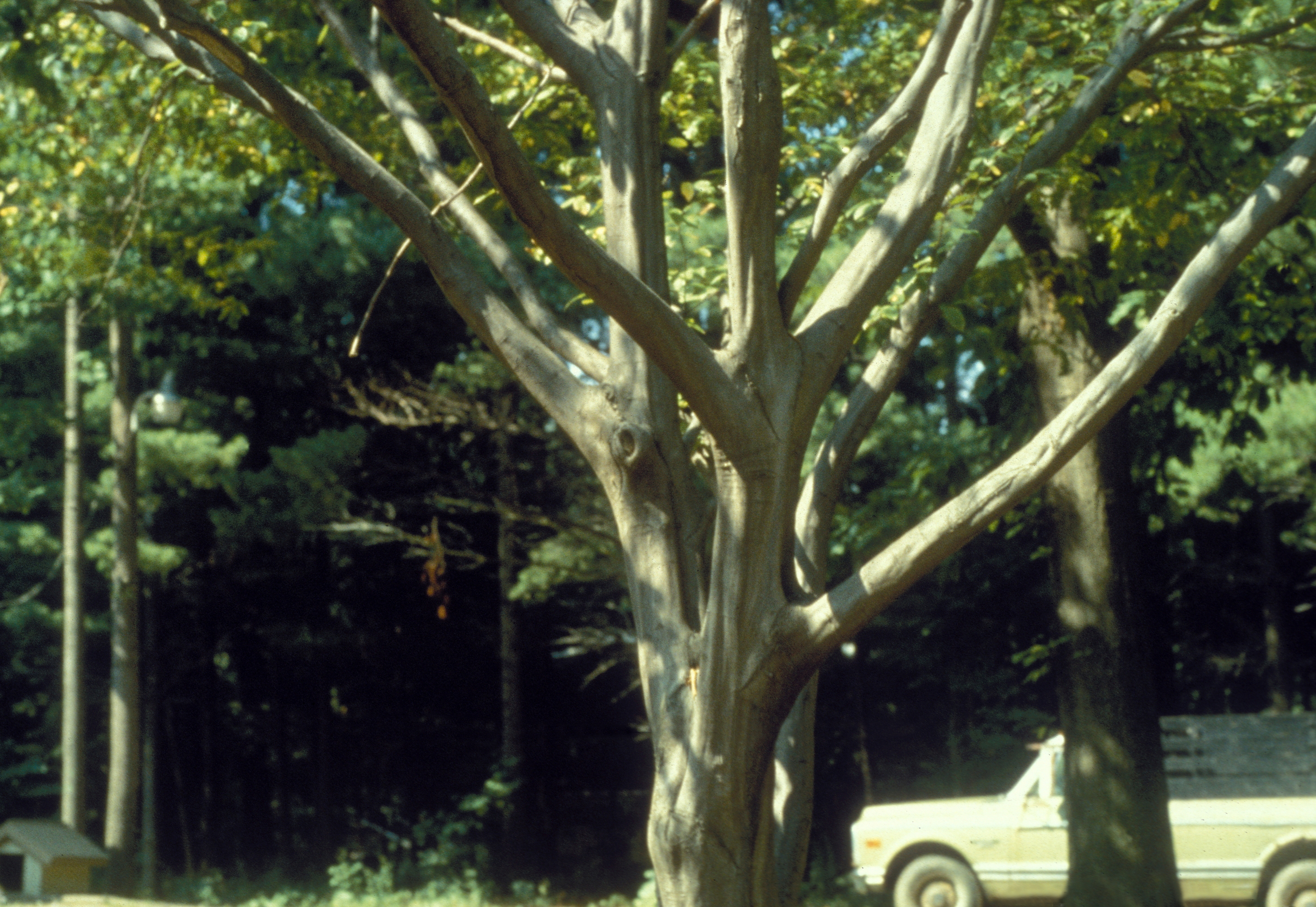
*Update #1: In the first edition of this post, American hornbeam (Carpinus caroliniana) was listed with the larger trees, but it is actually a small understory tree. It’s got a gorgeous form with this smooth ropy trunk that gives it the nickname Musclewood, mesmerizing wing-seeds, vibrant lime and deep green foliage, and attracts both birds and butterflies, as well as being a larval host for the Eastern Tiger Swallowtail, Striped hairstreak, Red-spotted Purple, Tiger swallow-tail (according to Lady Bird Johnson Wildflower Center), and the Io moth. Plant three of them! Nature plants in groves. The wood makes great small tool handles, but isn’t used commercially, so a nice niche item for hand craftsmen.


Flowering Pollinator Shrubs
Buttonbush (Cephalanthus occidentalis), snowberry (Symphoricarpos albus), coralberry (Symphoricarpos orbiculatus), Carolina buckthorn (Frangula caroliniana), marshmallow hibiscus (Hibiscus moscheutos), maple-leaf viburnum (Viburnum acerifolium), southern arrowwood (Viburnum dentatum), meadowseet (Spiraea alba), steeplebush (Spiraea tomentosa), white meadowsweet (Spiraea alba), the chokeberries (Aronia arbutifolia and A. melanocarpa), ninebark (Physocarpus opulifolius), witch hazel (Hamamelis virginiana), American hazelnut (Corylus americana), bottlebrush buckeye (Aesculus parviflora), and elderberry (Sambucus nigra ssp. canadensis).
*Update #2: In the first edition, I added pussywillow or Salix discolor after hearing about it on a podcast. It blooms early as do all the willows, supposedly easy to establish, and a champion nectar provider with a whole host of specialist pollinators who feed the pollen to their young! But this tree is not actually quite maybe native to Virginia this far south. The Digital Atlas of the Flora of Virgina says: ‘Known from just a single station in Virginia, a calcareous spring marsh in Augusta Co. […] This northern shrub willow is also frequently planted for ornament, but is not known to escape here.'” So, plant it as you will.

Perennial Pollinator Flowers
Since most of these are considered weeds, you might want to make sure it’s clear that your planting is intentional, maybe with defined beds, maybe with signs, and by planting masses or drifts (a lot of each kind of flower), which looks really good anyway!
Key: ** Very high and *High pollinator value according to Natural Resources Conservation Service (NRCS). + Goldenrods are a premium pollinator flower and not responsible for hay fever (that’s ragweed), and more info can be found here.
Dwarf goldenrod (Solidago nemoralis**+), showy goldenrod (Solidago speciosa*+), any native (non cultivar) goldenrod that you can manage (more on this below!), asters (smooth blue Symphyotrichum laeve,* New England S. novae-angliae,* New York S. novi-belgii*), butterfly weed (Asclepias tuberosa**), common milkweed (A. syriaca**), swamp milkweed (A. incarnata), (choose the milkweed native to your location and suited to your growing conditions), bee balm (Monarda fistulosa,** M. didyma), purple giant hyssop (Agastache scrophulariifolia**), fall phlox (Phlox paniculata), echinacea (E. purpurea*), spring beauty (Claytonia virginica), rose vervain (Verbena canadensis or Glandularia canadensis), liatris (L. spicata*), Virginia lion’s heart or obedient plant (Physostegia virginiana), black-eyed Susan (Rudbeckia fulgida), boneset (Eupatorium perfoliatum*), Virginia mountain mint (Pycnanthemum virginianum), Joe Pye weed (Eutrochium fistulosum*), spotted Joe Pye weed (Eutrochium maculatum*), New York ironweed (Vernonia noveboracensis*), lanceleaf coreopsis (Coreopsis lanceolata), wild indigo (Batpisia tinctoria), smooth penstemon (Penstemon digitalis), New Jersey tea (Ceanothus americanus), wild ageratum or blue mistflower (Conoclinium coelestinum can become invasive).
Noteworthy Pollinator Vines
Coral honeysuckle or trumpet honeysuckle (Lonicera sempirivens), yellow passionflower (Passiflora lutea), purple passionflower (Passiflora incarnata), virgin’s bower (Clematis virginiana), trumpet vine (Campsis radicans). Many of these are often considered invasive–plant with care, make sure you have some natural checks on its spread such as a wide mowed area around it or dark shade on one side of it and to avoid planting in small landscapes or near dwellings.
If you plant passionflower, you will probably attract carpenter bees, the obligate pollinator for this native flowering vine. If this worries you, first, look forward to the fruits of their labors–the fruits are edible and were harvested by First Nations peoples, a true delicacy to some today, and wouldn’t be possible without Xylocopa virginica, the humble carpenter bee, the only pollinator able to do the job. This is a great article written by someone who grew up eating maypops, including lots of how-to’s, photos of the flower, fruit and plant in various stages, and more.

This quote from Mr. Smarty Pants from the Lady Bird Johnson Wildflower Center about eating passionfruit, is choice:
“The seed-filled pulp of the fruit is the part that is eaten. The fruits of some individual plants are tastier than those on other plants of the species. Some people do not care for the taste at all. There probably is not an Emily Post-like way of eating maypops, but children just seem to know that you should break them open – they often make an audible pop in the process – and squeeze the contents, seeds and all, into your mouth where you strain and swallow the sweet-tart pulp and spit out the glob of seeds. Dainty no, delicious yes.”
– from Edibility of Passiflora incarnata at wildflower.org.
Worried About Carpenter Bees Attracted to Your Flowers?
You can put out carpenter bee houses to prevent them from nesting in your wood siding or other structures, which I can testify works great! Catch up on the whole carpenter bee house saga here.
The featured image for this post was taken at Spikenard Honeybee Sanctuary in mid-July. These are Monarda fistulosa (wild bergamot) blossoms and Xylocopa virginica (carpenter bees) feeding on the bloom. My own bees haven’t fared as well and disappeared by mid-June. I assumed the bees had what they needed from the environment when I decided in May not to plant flower food for them (also I was trying to avoid Michael’s fears of an infestation), but now I’m sad because they felt like pets! It’s really ironic, I know, given that we built the bee house as “pest deterrent.” Along the way, we removed the ‘s.’
Planting for a Specific Pollinator
There are SO MANY native pollinators, from bees and wasps to flies and butterflies to moths and hummingbirds! If you have a favorite pollinator you want to support and enjoy, make sure to plant not only its favorite foods (its nectar source) but its larval host plants (caterpillar food). For example, the amazing hummingbird moth Hemaris thysbe lays its eggs on honeysuckle (Lonicera), snowberry (Symphoricarpos), hawthorns (Crataegus), cherries and plums (Prunus), and dogbane (Apocynum cannabinum). Once in flying moth form, it eats Lonicera, Symphoricarpos, Monarda fistulosa (which is where I saw it feeding up at Spikenard Honeybee Sanctuary), rose vervain (Verbena canadensis), and other pink and purple flowers. I’d recommend the native Lonicera sempirivens rather than Lonicera japonica, but have found articles recommending the latter for attracting this charismatic moth.
Another high profile example is our endangered monarch butterfly which needs Asclepias milkweed to host the caterpillars and on which to pupate. Once the butterfly emerges, it forages on a variety of flowers, including both Southwest Virginia natives and Mexican natives such as zinnias. Scroll down for a number of resources by Xerces Society, NRCS and others on native flowers to plant to help both monarch butterflies and pollinators in general.
UPDATE!

Xerces Society Resources
- Pollinator Conservation Resource Center (North America)
- Pollinator Conservation Resources (Mid-Atlantic)
- Mid-Atlantic Native Meadows Guide
- Meadow Site Preparation Guide
- Pollinator Trees and Shrubs
- Pollinator Plants (Mid-Atlantic)
- Monarch Butterfly Nectar Plants (Mid-Atlantic)
- Farms and Agricultural Landscapes for Beneficial Insects
- Firefly Tourism Flyer
- Bee Safe Plants
Lady Bird Johnson Wildflower Center’s Plant Lists
NRCS (Natural Resource Conservation Service)
Links
36 Deer Foods Every Hunter Should Know https://www.fieldandstream.com/story/hunting/deer-foods-every-hunter-should-know/
Appalachian flowers with pictures: https://amcdv.org/octember.html
Approximate bloom times in Southern Appalachia: http://www.ncnatural.com/wildflwr/blmtime.html
Permaculture Orchard https://www.permacultureorchard.com/
YouTube Channel for Stefan Sobkowiak (Permaculture Orchard) https://www.youtube.com/c/StefanSobkowiak
Green Spring Gardens, Fairfax, VA Pollinator Plants https://www.fairfaxcounty.gov/parks/sites/parks/files/assets/documents/nature-history/greenspring/infosheets/butterfliesandmoths.pdf
Native Passionfruit (Passiflora incarnata): How to Find, Harvest, ID, Grow and Eat https://www.tyrantfarms.com/find-id-harvest-grow-eat-passion-fruit-maypop-passiflora-incarnata/