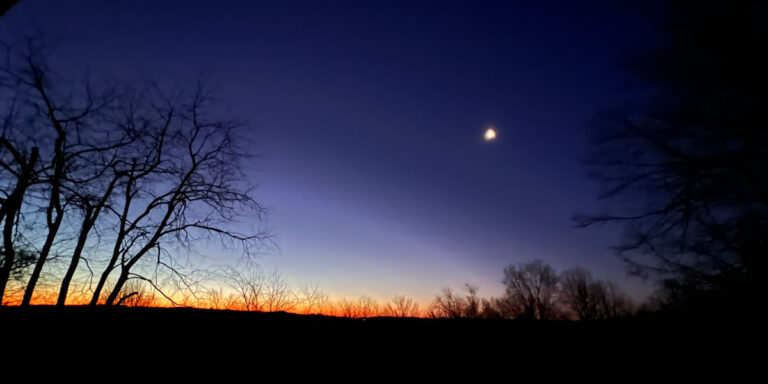

Featured Image: Morning Star by Kate Russell, CC BY 2.0, via Wikimedia Commons
Heliacal Rising
“The heliacal rising (/hɪˈlaɪ.əkəl/ hih-LY-ə-kəl) of a star or a planet occurs annually, when it becomes visible above the eastern horizon at dawn in the brief moment just before sunrise (thus becoming “the morning star”).” (Wikipedia, 2026) Venus’ heliacal rise differs from other heliacal rises because of its inferior orbit inside Earth’s orbit, and recurs every 1.6 years. Jump to Venus’ Heliacal Rise.
Heliacal Rise of Fixed Stars
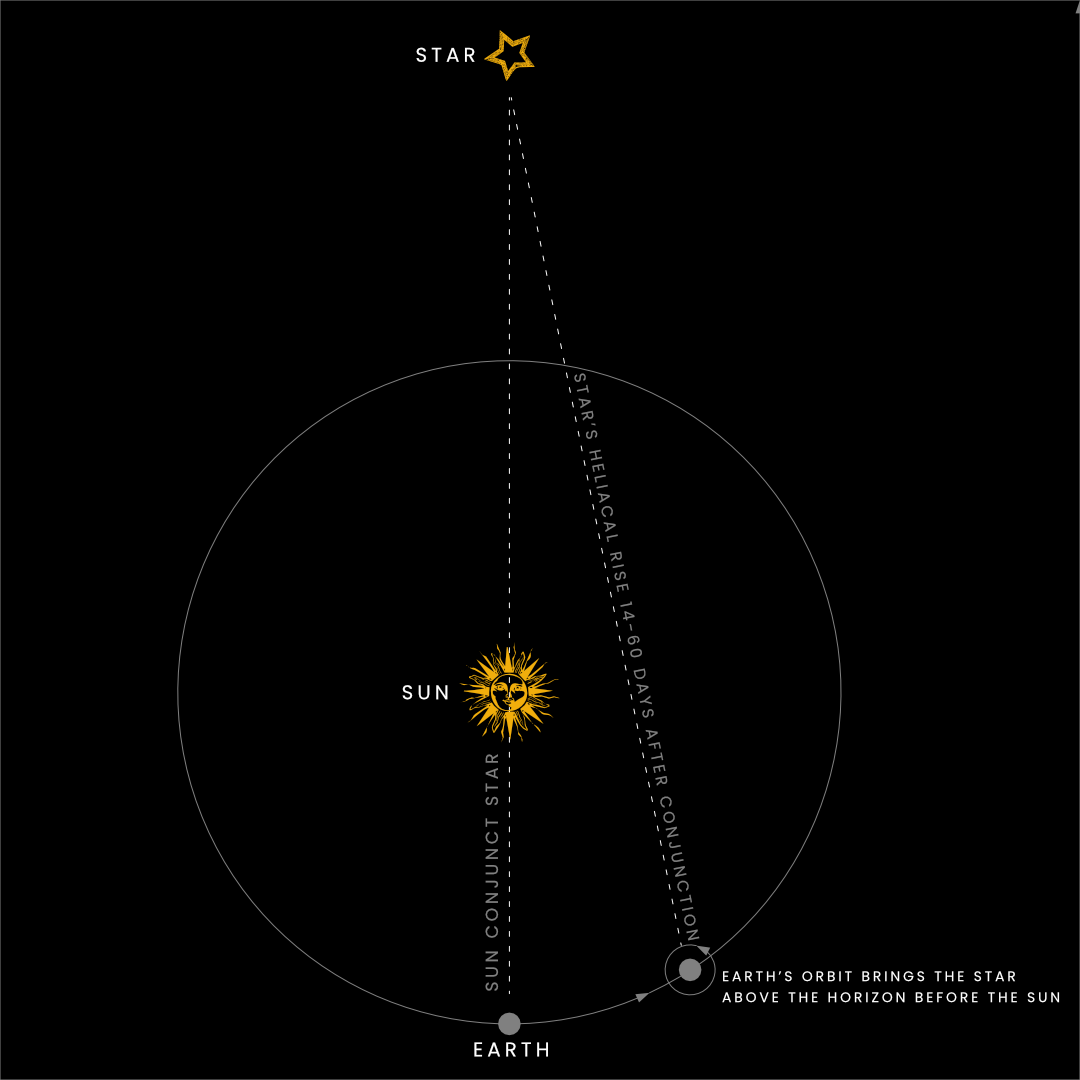
For fixed stars, the heliacal rise is an annual phenomenon that occurs after we line up with the sun between us and the star. This alignment is known as the conjunction of the sun and the star. For days before, during, and after the exact conjunction, the star disappears, lost in the sun’s glare. Astronomers call this “occultation by the sun.”
Morning Star
As the Earth continues in its orbit, our perspective puts more of a gap between the sun and the star, so that 14-60 days after the conjunction, the star rises just before sunrise for the first time in a year. This moment is the star’s heliacal rise and it will spend the next few months as a “morning star.” The precise moment of a star’s heliacal rise varies based on the star’s celestial coordinates, its brightness, and the observer’s latitude, as well as more ephemeral factors such as weather. Scroll down for a similar diagram of Venus’ heliacal rise as Morning Star.
Evening Star
The six months that follow the heliacal rise carry the Earth to a second major alignment with that star. This time, we line up between the sun and the star: the sun and the star oppose each other. At this point, the star rises at sunset for the first time in a year and becomes a prominent feature of the evening sky, an “evening star.”
Interestingly, in our era, this evening star phase is more widely observed than the predawn morning star phase. Unlike our pre-industrial ancestors, we are far more likely to be awake and outdoors after sunset than before sunrise. Electric lights have extended the workday and the social hour until long after dark on a regular basis, and so, many people are likely to see the stars in the evening. Whereas, many of us don’t see the sky in the hour before sunrise. Many of our ancestors would rise early to care for animals or begin the workday, and it was common for them to be outside every day looking up at a sky unobscured by light polution. In the modern era, if we are up before first light, we’re usually indoors, eating breakfast, watching t.v., or checking our phones or our email. The modern lifestyle seems to have more occasion for noticing the sky in the evening than before sunrise.
Heliacal Rise of Planets
For planets, the heliacal rise does not follow the same annual rhythm because planets are in motion orbiting the sun along with us. The fixed stars shine from far beyond our solar system, and do not appear to move, functioning a bit like the sky’s wallpaper, whereas the planets are like other cars on the same race track, moving at different paces from our own.
Still, the planets do have a heliacal rise from the perspective of Earth. None repeat perfectly like clockwork because most orbital patterns are somewhat to highly eliptical. What this means is that, although the big mathematical models can precisely calculate and predict the planetary heliacal risings, their general cycles vary from period to period:
- Uranus: approximately every 369 days
- Saturn: approximately every 378 days.
- Jupiter: approximately every 399 days.
- Mars: approximately every 26 months.
- Venus: approximately every 584 days.
- Mercury is not considered to have a heliacal rise as it orbits so close to the sun and has a more complex pattern, appearing in the morning and evening skies several times a year.
Heliacal Rise of Venus
For Venus, the heliacal rise is a little different than for the outer planets because Venus orbits inside of our orbit (this is called an inferior orbit). It recurs every approximately 584 days or 1.6 years, and marks the start of its roughly eight month period as the Morning Star.
The transition to the Morning Star phase begins when Venus turns retrograde during its Evening Star phase, appearing to move backwards against the backdrop of stars. The geometry of this alignment occurs when line of sight from Earth makes a tangent to Venus’ orbital path.
Venus Morning Star
Because Venus’ orbital path is shorter than Earth’s, and it moves more quickly (~35 km/s vs. ~29.8 km/s), it passes from its tangent alignment (the turn retrograde) to the inferior conjunction between Earth and the Sun in just 20 days. In only seven more days, Venus pulls ahead of Earth to reach ~10 degrees separation from the Sun from Earth’s perspective. At this moment, Venus clears the sun’s glare enough to be visible before sunrise, rising as Morning Star for the first time in 1.6 years. It is very close to Earth right now, making it very bright, a dramatic event to witness.

Many ancient cultures held rituals and celebrations or even went to war upon Venus’ heliacal rise. This observation was also very important for rectifying calendars. The heliacal rise of other stars like Sirius and the Pleiades held similar importance, adding deeper archaic echoes to the significance of Venus’ heliacal rise. For this reason, Venus synodic cycle pioneers, Daniel Giamario and Cayelin Castell (Shamanic Astrology, Turning of the Ages Mystery School, Venus Alchemy), count the start of the cycle from Venus’ heliacal rise, which happens about a week after the inferior solar conjunction.
If you choose to mark the beginning of the Venus Cycle from its heliacal rise, you will probably choose to use astrological software to calculate the moment when Venus reaches ten degrees separation from the sun, rather than the real-life moment an Earth-based observer can first see the Morning Star, which method the ancients used by necessity. And indeed, TOTAMS uses software rather than field observation. This is because local viewing conditions vary so widely that it would be impractical to calculate and predict for every location. Online tools do exist for predicting Venus’ visibility in your location, such as in-the-sky.org, but it is a tricky process that doesn’t always line up with the reality on the ground. For this reason, I use the inferior conjunction to mark the beginning of the Venus Cycle. Read more here.
Anyone tracking the Venus Cycle today would benefit from watching for the rise of the Morning Star and casting the chart for the first moment they see it in the east. An advanced project might precisely track the heliacal rise of Venus in your location across multiple cycles, working with the charts for those moments, trusting that your observation will be perfect for you through the power of synchronicity. Simply note the date and time of your observation, and calculate the chart later for study.